
'Political parties are following the Divide and Rule policy to break the unity of farmers.'

Giving a relief to exporters community, the government on Thursday said it will release Rs 56,027 crore to exporters against pending tax refunds under different incentive schemes for outbound shipments. The amount will be disbursed to more than 45,000 exporters. Briefing the media about the decision, Commerce and Industry Minister Piyush Goyal said that the Rs 56,027 crore, which is being released under various export promotion schemes, is over and above duty remission of Rs 12,454 crore for the Remission of Duties and Taxes on Export Products (RoDTEP) Scheme and Rs 6,946 crore for Rebate of State and Central Levies and Taxes (RoSCTL) Scheme already announced.

Foreign Direct Investment flows to India in 2021 were 26 per cent lower, mainly because large M&A deals recorded in 2020 were not repeated, the UN trade body has said.

With a combination of both physical and virtual exhibition, the 13th edition of the biennial international event at Air Force Station Yelahanka will be the world's first hybrid aerospace show.

Prime Minister Modi arrived in Riyadh late Monday night on a two-day visit to Saudi Arabia to participate in the high-profile financial summit Future Investment Initiative, dubbed "Davos in the desert", an initiative of Saudi Crown Prince Mohammed bin Salman.
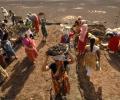
'MGNREGA is definitely like a lifeline and is the employer of the last resort'

Consumer price-based index of products consumed by agricultural labourers rose to 17.21 per cent in December compared to 15.65 per cent in previous month, a Labour Bureau statement said on Wednesday. However, inflation measured by wholesale prices was 7.31 per cent in December.

Eight of the 30 companies in the BSE Sensex that shared data reported 99 fatalities in 2016-17 against 86 in the previous year. These lives were lost due to industrial accidents at manufacturing facilities. Fatalities owing to road accidents were excluded from the count.

The Delhi Metro will operate at 50 per cent capacity and markets and malls in the national capital will open on an odd-even basis from June 7, Chief Minister Arvind Kejriwal said on Saturday as he announced further relaxations in lockdown.

'Politicians's slogans on social distancing, showered like petals from their ivory towers, mock every single moment of pain and distress imposed on the vulnerable down below, at migrant labour stuffed like chickens on goods trucks, trying to get home at all costs,' observes Veenu Sandhu.
'Fear psychosis has gripped the entire world.' 'Nobody is going to enter shops freely in the next 5, 6 months.' 'Secondly, the priority has changed.' 'Now that they have seen the bottom of the economy, people will prefer to save for tomorrow.'

India's growth projection released by the latest World Economic Outlook remains unchanged from its previous WEO (World Economic Outlook) update of July this summer but is a three-percentage point in 2021 and 1.6 percentage point drop from its April projections. According to the latest WEO update, released ahead of the annual meeting of the IMF and the World Bank, the world is expected to grow at 5.9 per cent in 2021 and 4.9 per cent in 2022.

Future Group and V-Mart have put in place systems to prevent panic buying at their neighbourhood grocery stores.
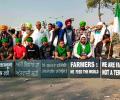
'Had these three farm laws existed it would have become a huge election issue.'

India has entered a 'demographic sweet spot' with half of its population being under the age of 29. This 'demographic dividend' is likely to last for 2-3 decades and provides the government a unique opportunity to harness the vast potential of India's youth, points out Raj Kishore Mishra, the former civil servant turned development professional.

Average salary has grown faster than average business income for three of the last five years. This has implications in a country like India. Most people in India are self-employed, with 51.4% of the population falling in that bracket.

Access to India's defence market must be made conditional -- available only to those who are ready to make a long-term commitment in India, argues Ajai Shukla.

Indians want change and progress. They should be willing to accept tough decisions, says Sanjeev Nayyar.

However, several other Indian products continue to be in this list.

The Budget would have been the perfect vehicle to introduce some bold initiatives.
That opportunity has been lost through this Budget, observes Shreekant Sambrani.
The challenge for politicians is that the continuous electoral cycle favours short-termism and the loan waiver type of policy, whereas prosperity requires hard decisions where commonly held perceptions must be disrupted and over-turned, says Dhiraj Nayyar.

Has Make in India's mascot, the metal lion, begun to rust?

One Chinaman is three time more productive than an Indian at the workplace through his life, observes Virender Kapoor.

Amid fears of a third wave of coronavirus pandemic and hardening of retail inflation, the Reserve Bank is likely to maintain status quo on interest rate and watch the developing macroeconomic situation for some more time before taking any decisive action on monetary policy. The RBI is scheduled to announce its bi-monthly monetary policy review on August 6 at the end of the three-day meeting -- August 4-6 -- of the Monetary Policy Committee (MPC). The RBI Governor-headed six-member MPC decides on the key policy rates.

'There is a vision in the Budget, and the vision is to take India from a largely agrarian, rural economy into a fast-track digitalised economy.'

Will people buy as many cars as before if more office-goers are working from home? How much existing office space in commercial buildings will become surplus, and what will that mean for the construction industry, asks T N Ninan.

The loss of job opportunities in recent times has been so severe that labour stopped even looking for jobs, says Mahesh Vyas.
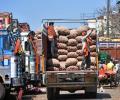
In the last one week several companies have had to face the hurdle of making a distinction between what's essential and what's not. To help them the government has now clarified that grocery would include hygiene products such as hand wash, soaps, disinfectants, body wash, shampoo, surface cleaners, detergents, tissue paper, toothpaste, oral care, sanitary pads, diapers, chargers and battery cells, etc.

We will find it difficult to exceed an average of 5 per cent growth in the medium term, warns Shankar Acharya, the former chief economic adviser.

With the government looking to divest loss-making steel assets, significant interest from secondary players is most likely this time apart from the anticipated list of large integrated primary steel producers, said industry experts. Rashtriya Ispat Nigam Limited (RINL), Neelachal Ispat Nigam Ltd (NINL), NMDC Integrated Steel Plant (NISP)-Nagarnar, Ferro Scrap Nigam Ltd and three units of Steel Authority of India (SAIL) - Alloy Steels Plant, Durgapur; Visvesvaraya Iron and Steel Plant, Bhadravati; and Salem Steel Plant, Salem - constitute the divestment list. All the three units of SAIL have been loss-making for more than five years.

Bengaluru's manufacturing sector has in the past few years witnessed one of its worst phases, thanks to labour unrest in the region's industrial hub.
Later, there may be some tax relief aimed at the middle class and measures to benefit the sectors worst hit by Covid-19 and the resultant nationwide lockdown.

Observing that India's worsening COVID-19 situation and the strict measures to contain it have hit the economy hard, the rating agency said productive capacity has been severely disrupted since the start of the pandemic.
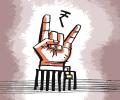
Construction companies will make money building detention centres. Information technology companies will make money on the enumeration of the CAA, NRC and NPR, notes Devangshu Datta.

'The stories I want to tell are very important.'

'Agriculture has been given the wrong kind of attention.' 'More innovations are needed for the sector to be successful,' says Devi Murthy of Kamal Kisan.
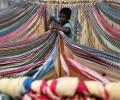
Since he lives locally, Harish Patel is one of the luckier migrant workers in Surat - in that his employer was able to squeeze in a single shift for him at the weaving unit in Kamrej in Gujarat - unlike others who went home for Holi and other festivals just as the second wave of the Covid-19 pandemic was waxing and ended up stranded in local lockdowns.
Blaming earlier policies for "discriminating" against labour intensive sectors and leading to "significant deceleration" in employment, Planning Commission Deputy Chairman Montek Singh Ahluwalia on Friday

The RBI on Friday said the impact of coronavirus outbreak on the economy will depend on the intensity, spread and duration of the deadly virus even as the central bank refrained from projecting any numbers for growth and inflation amid the widespread uncertainty. While announcing the seventh bi-monthly monetary policy statement for 2019-20, RBI Governor Shaktikanta Das said that in view of the impact of coronavirus pandemic, the growth projections for 4.7 per cent for the fourth quarter of 2019-20 and 5 per cent for the full fiscal are "now at risk".

''Fashion without a conscience is a ticking time bomb.'
